
Call us now :+918830563789
 Send Inquiry
 Send Inquiry
UD-4000 Low Temperature Retraction Tester
MOQ : 1 Set
UD-4000 Low Temperature Retraction Tester Specification
- Accuracy
- ±0.5 mm for retraction measurement, ±1°C for temperature control
- Usage & Applications
- Determining low-temperature retraction properties of vulcanized rubber or elastomers
- Resistant Feature
- Corrosion and low-temperature resistant
- Pressure
- Ambient atmospheric
- Product Type
- Low Temperature Retraction Tester
- Material
- Cold-rolled steel body, powder coated finish
- Measuring Voltage Range
- 220-240V AC, 50Hz
- Operating Temperature
- -70°C to 0°C (adjustable)
- Frequency (MHz)
- 50 Hz (power supply frequency)
- Insulation Box
- Yes, integrated insulation chamber
- Protection System
- Safety interlock, over-temperature protection
- Size
- Standard laboratory benchtop
- Color
- Blue and white
- Dimension (L*W*H)
- Approx. 650 mm x 430 mm x 500 mm
- Weight
- Approx. 45 kg
- Cooling Rate
- Up to 1.5°C/min (programmable)
- Heating Rate
- Up to 10°C/min (programmable)
- Retraction Test Speed
- Automatic, adjustable as per test method
- Power Supply
- 220V AC, 50Hz
- Timer Function
- Digital timer with alarm
- Coolant
- Liquid nitrogen or suitable refrigerant
- Retraction Measurement Range
- 0~100 mm or as per standard requirement
- Control System
- Microprocessor-based digital controller
- Display
- Digital LED/LCD display for temperature and retraction
- Compliance Standard
- ASTM D1329 or equivalent
- Test Capacity
- Up to 6 samples per run
- Accessories Included
- Sample holders, tongs, calibration gauge
- Sample Clamping Device
- Multi-point clamping mechanism
UD-4000 Low Temperature Retraction Tester Trade Information
- Minimum Order Quantity
- 1 Set
- Supply Ability
- 30 Sets Per Month
- Delivery Time
- 45-90 Days
About UD-4000 Low Temperature Retraction Tester
Specification
- Manufacturing Standards: ASTM D 1329, ISO 2921, JIS K 6261
- Temperature: -70 degree C - 0 degree C (depending on heat transfer liquid used)
- Temperature resolution: 0.1 degree.
- Temperature check: By means of heat regulator with PID microprocessor with 0.1 degree C accuracy.
- Cooling system: Liquid nitrogen with internal heat exchanges.
- Test Chamber: Test chamber capacity of 5 liters.
- Chamber material: Stainless steel.
- Sample holder: 6 samples
- Instrument dimensions: 500 x 500 x1900 mm (W x Dx H)
- Weight: 210kg.
- Electric Supply: AC 220V+/-10%, 50Hz +/- 3Hz, 4A, Single Phase.
Precision Low-Temperature Testing for Elastomers
The UD-4000 Low Temperature Retraction Tester is specifically designed to evaluate the low-temperature performance of vulcanized rubbers and elastomers. By simulating harsh environments down to -70C, the instrument ensures reliable measurement of material retraction. Its advanced programmable controls and automatic test speeds allow for efficiency and reproducibility, providing confidence in quality assurance and research settings.
User-Friendly Digital Controls and Multiple Sample Testing
This tester features a microprocessor-based digital controller with a clear LED/LCD display for easy monitoring of both temperature and retraction. With multi-point clamping and capacity for up to six samples per run, users benefit from increased throughput and consistent results. Accessories such as sample holders, tongs, and a calibration gauge are supplied for immediate operation, emphasizing convenience and safety.
FAQ's of UD-4000 Low Temperature Retraction Tester:
Q: How does the UD-4000 tester determine the retraction properties of rubber samples?
A: The UD-4000 measures the retraction properties by exposing rubber or elastomer samples to low temperatures using liquid nitrogen or a similar refrigerant. The apparatus automatically controls cooling and heating rates, then monitors the distance the material retracts, with all data displayed digitally. This precise process ensures reliable assessment of material performance under cold conditions.Q: What materials are suitable for testing with the UD-4000 Low Temperature Retraction Tester?
A: This instrument is ideal for testing vulcanized rubbers and general elastomers according to ASTM D1329 or equivalent standards. It's utilized by manufacturers, suppliers, and researchers assessing cold flexibility and durability of these materials.Q: When should the UD-4000 be used in a laboratory setting?
A: The UD-4000 should be employed during the quality control of rubber goods, research and development of new elastomer formulations, or any scenario where performance at low temperatures is critical. Its programmable ramp and cooling rates suit various standard and custom test protocols.Q: Where can the UD-4000 be installed for optimal performance?
A: This benchtop instrument has a compact design (approx. 650 x 430 x 500 mm) and is intended for standard laboratory environments. Ensure installation in a well-ventilated area with access to a 220V AC power supply and suitable refrigerant storage for safe operation.Q: What is the process for running a low-temperature retraction test with the UD-4000?
A: First, prepare the samples and load them using the included sample holders and clamping device. Set the desired test parameters, including temperature and ramp rates, via the digital controller. The tester will automatically cool, maintain, and then heat the samples while measuring retraction, with results shown on the display.Q: How does the safety system of the UD-4000 ensure user protection?
A: The UD-4000 is built with safety interlocks, over-temperature protection, and an insulated chamber to protect users from extremely low temperatures and accidental exposure to refrigerants. The corrosion-resistant, powder-coated body also promotes long-term durability in laboratory settings.Q: What are the main benefits of using the UD-4000 for low-temperature retraction testing?
A: Key benefits include high accuracy, programmability for multiple standards, capacity for simultaneous multi-sample testing, user-friendly digital controls, and robust safety features. These attributes help organizations streamline quality assessments and R&D, ensuring materials meet stringent industry requirements.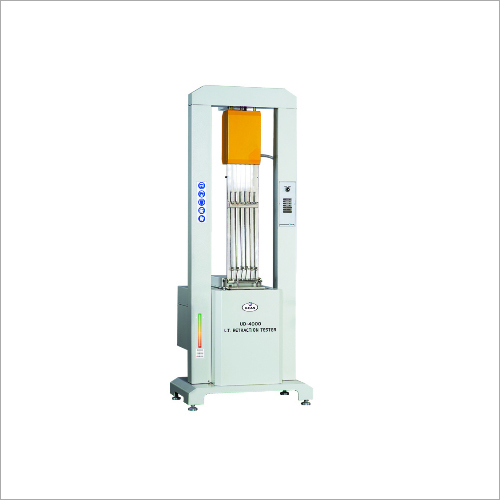
Tell us about your requirement

Price:
Quantity
Select Unit
- 50
- 100
- 200
- 250
- 500
- 1000+
Additional detail
Mobile number
Email


 Send Inquiry
Our Products
- Rubber and Testing
- Tyre Plunger Testing System
- PVTC Analyzer
- Comprehensive Environmental Testing Machine
- Tensile Strength Tester
- Dynamic Testing System
- Ozone Tester Chamber
- PVT Tester
- Dynamic Fatigue Tester
- Rebound Resilience Elasticity Tester
- Electronic Densimeter
- Low Temperature Retraction Tester
- Tire Section Cutting Machine
- Rubber Process Analyzer
- Optimum Cure Analysis System
- Hydraulic Sample Press
- Rheometer
- Universal testing machines
- Rubber Testing Machine
- Pressure Rheometer


B No. 26, Houkou S. Rd, Houli Township, Central Taiwan Science Park, Taichung - 42152, Taiwan

Ms Kelly Hsieh
(Manager)
Mobile :+886966852722, +886972393052, +910972393052, +919946307303, +918830563789
Mr. Vinoth Pitchaimuthu
Mobile :+886971874352
 Send Inquiry
 Send SMS
Developed and Managed by Infocom Network Private Limited.


